|
How
is vision possible?
OPTICS
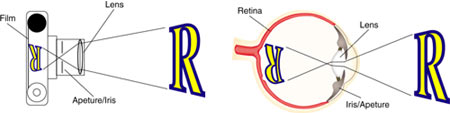
RETINAL IMAGE -- light reflects off of objects in the world, it passes through the LENS at the front of the eye and it is focused at the back of the eye. -- the LENS also flips the image upside down in the process of focussing it to a small point 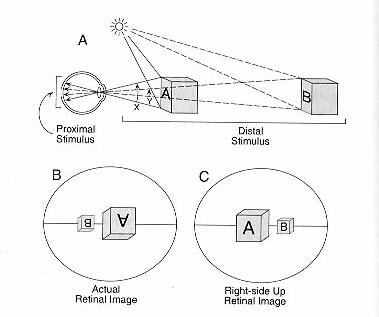
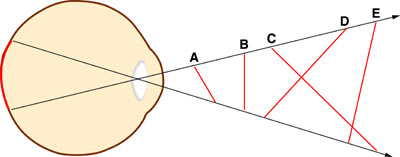
Consider this RETINA IMAGE
It could be caused by FIVE very different objects.
(B) is a chopstick standing straight up-and-down a foot away (C) is a round curtain rod (D) a piece of wood dowling (E) is a polevault How does our visual system take the information that it receives from the world -- the two-dimensional, upside-down image in B -- and produce in us an experience of the rich three dimensional world? -- Stereoscopic vision (information from 2 eyes) MAIN POINT -- Your brain is doing a TREMENDOUS AMOUNT OF PROCESSING 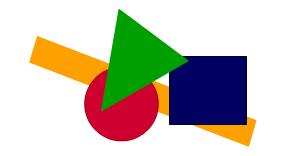 How many objects do you see?
For one object to be occluded by another is for it to be partially obscured or hidden behind it. We see the circle as occluded by the triangle, the square occluded by the triangle, and so on. THERE WAS A MISTAKE IN THE ONLINE DESCRIPTION!!! -- DID YOU CATCH IT???? But why do we "see" the image in that way?
There is nothing in the image itself that points to a three-dimensional
space.
The picture is ambiguous because it can be interpreted in more than one way. Every time that you look at the world, the image projected on your retina has only two-dimensions and also can be interpreted as indicating the existence of more than one three-dimensional situation in the world. So our visual system must overcome the inverse
problem. How can we learn WHAT the BRAIN is doing and HOW it is doing it?
|