|
Introduction to Visual Illusions
OPTICS
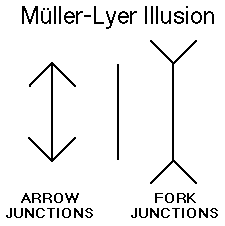
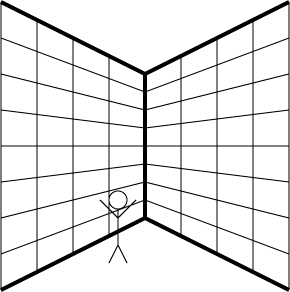
PROJECTIVE GEOMETRY  If we are trying to represent 3 men of the same height, the picture on the right VIOLATES the laws of projective geometry. So this is an illusion, of sorts. The pictures of the men are in fact exactly the same size, but the one on the end APPEARS taller. Illusions, then, are especially important in the study of vision, because they provide dramatic clues concerning the underlying assumptions that are built into our visual systems. The Müller-Lyer Illusion
The Linear-Perspective Hypothesis A linear perspective drawing is produced when an artist draws on a flat (two-dimensional) surface and uses line drawings to create objects that appear to have three-dimensions. The artist takes advantage of projective geometry. Our visual system expects objects that are further away to appear smaller.
Hypothesis TestingThe linear perspective hypothesis makes sense, but is it a good explanation of the illusion? Experimental tests of this kind can provide some evidence in support of a hypothesis (like the linear pespective hypothesis), but an hypothesis can never be "proven" because other explanations always remain possible.
Methods Used to Study Vision INTROSPECTION
-- present human subjects with stimuli, observe their behavior NEUROSCIENCE RESEARCH COMPUTER MODELING |
|||||||||